
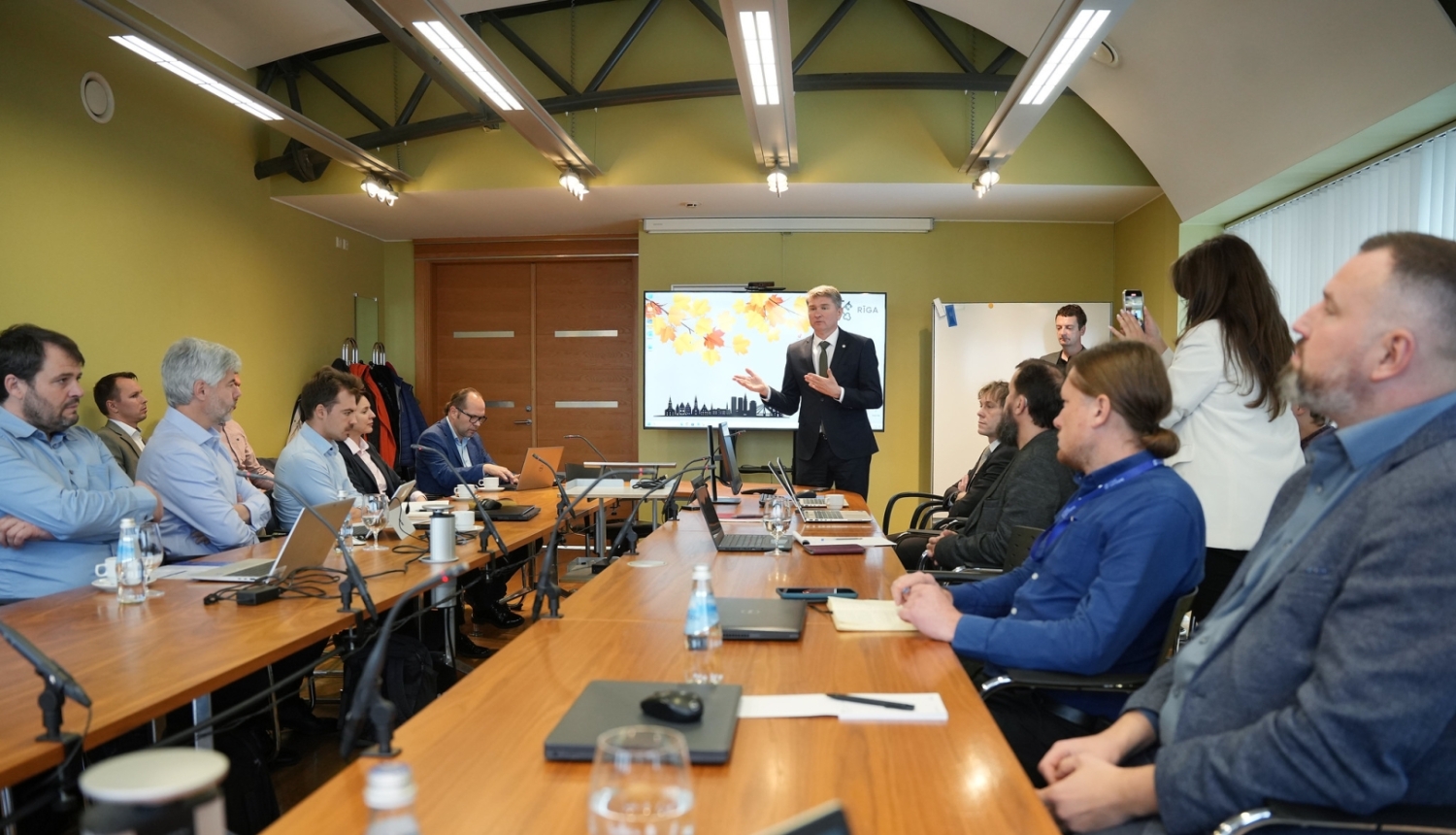
To create a unified transport infrastructure and public transport system across the entire Riga metropolitan area, the Riga City Council, in collaboration with local governments of the greater Riga area (Pieriga), relevant ministries and businesses, as well as the European Investment Bank (EIB), has begun work on developing the Riga Metropolitan Area Mobility Plan (RMAMP). To discuss the planned cooperation, EIB representatives and consultants visited the Riga City Council this week and met with the RMAMP working group.
EIB expertise crucial for determining investment priorities and the financing strategy
The cooperation agreement concluded between the Riga City Council and the European Investment Bank provides for consultancy from qualified transport and mobility experts to establish the strategic, methodological and governance framework for the plan, ensuring its compliance with European Union guidelines and decarbonisation targets.
“This cooperation with the EIB is not just about drawing up yet another planning document, but plays a much broader role — for the first time, Riga, in collaboration with European experts, will develop a unified approach to mobility planning and management across the Riga metropolitan area, the likes of which has never been seen before. This will enable us to base our decisions on an internationally proven approach and make faster progress,” explains Māris Sprindžuks, Vice-Mayor of the Riga City Council for Urban Development and Riga Metropolitan Area Matters. “The population of the Riga metropolitan area has grown over recent decades and urban sprawl has occurred, but the transport system has not kept pace with this. Therefore, the EIB’s expertise is particularly crucial in helping to determine investment priorities, as well as sources of funding and a financing strategy — one of the critical aspects in ensuring that this planning work translates into tangible action.”
In collaboration with experts from the European Investment Bank, an action plan for public transport reform will be developed and the Riga public transport network will be restructured.
The experts will assist in evaluating the investment programme for the decarbonisation of public transport by analysing the vehicle fleet, infrastructure and funding. A comprehensive analysis of the bus and other public transport fleets, the necessary infrastructure and financing requirements will be carried out to identify primary investment priorities. Furthermore, a programme implementation and financing strategy will be designed to ensure a gradual transition to public transport aligned with climate targets by 2035.
The Riga Metropolitan Area Mobility Plan scheduled for completion by the end of 2027
The Riga Metropolitan Area Mobility Plan (internationally known by the acronym SUMP — Sustainable Urban Mobility Plan) is a strategic, long-term planning document aimed at establishing a unified vision and approach to the development of the transport system throughout the Riga metropolitan area, including improving connectivity, mobility and the region’s competitiveness. This will provide a unified framework for sustainable mobility development and assist in coordinating the necessary solutions and investments to meet the daily commuting needs of residents in Riga and Pieriga.
During the development of the plan, particular attention is being paid to the integration of the transport network between Riga and Pieriga, the development of environmentally friendly modes of transport, and the planning of data-driven investment projects. This will promote convenient, safe and accessible commuting options for all residents.
The designated working group is analysing the current mobility situation in the areas of pedestrian mobility and micromobility, public transport, freight logistics, deliveries, private vehicle traffic and multimodality. The findings of this analysis will help to define development scenarios and priority courses of action up to 2050.
The plan also entails evaluating the integration of major infrastructure projects into the overall transport system, determining the necessary investments and deploying a mobility data and monitoring system to track the plan’s implementation and milestones. The plan developers will analyse traffic flows, residents’ mobility habits and the utilisation of existing infrastructure, and will continue to organise public engagement.
The Riga Metropolitan Area Mobility Plan is scheduled to be finalised and approved by the end of 2027.
The core territory of the Riga metropolitan area comprises the cities of Riga and Jūrmala, as well as the municipalities of Mārupe, Olaine, Ķekava, Salaspils, Ropaži and Ādaži. The area of influence also extends to the municipalities of Saulkrasti, Sigulda, Ogre, Jelgava and Tukums, as well as the city of Jelgava.
The development of the plan is led by the Riga City Council in close cooperation with the Ministry of Transport, the Ministry of Smart Administration and Regional Development, the Riga Planning Region, the local governments in Pieriga, and transport sector companies such as ‘Rīgas Satiksme’, ‘Pasažieru Vilciens’ (Vivi), ‘Latvijas dzelzceļš’, ‘Latvijas Valsts ceļi’ and the Road Transport Directorate, whose representatives are members of the RMAMP working group.
Further information: Tatjana Smirnova, Project Coordinator of the External Communications Division of the Communication Department of Riga City Council, e-mail: tsmirnova11@riga.lv.
