


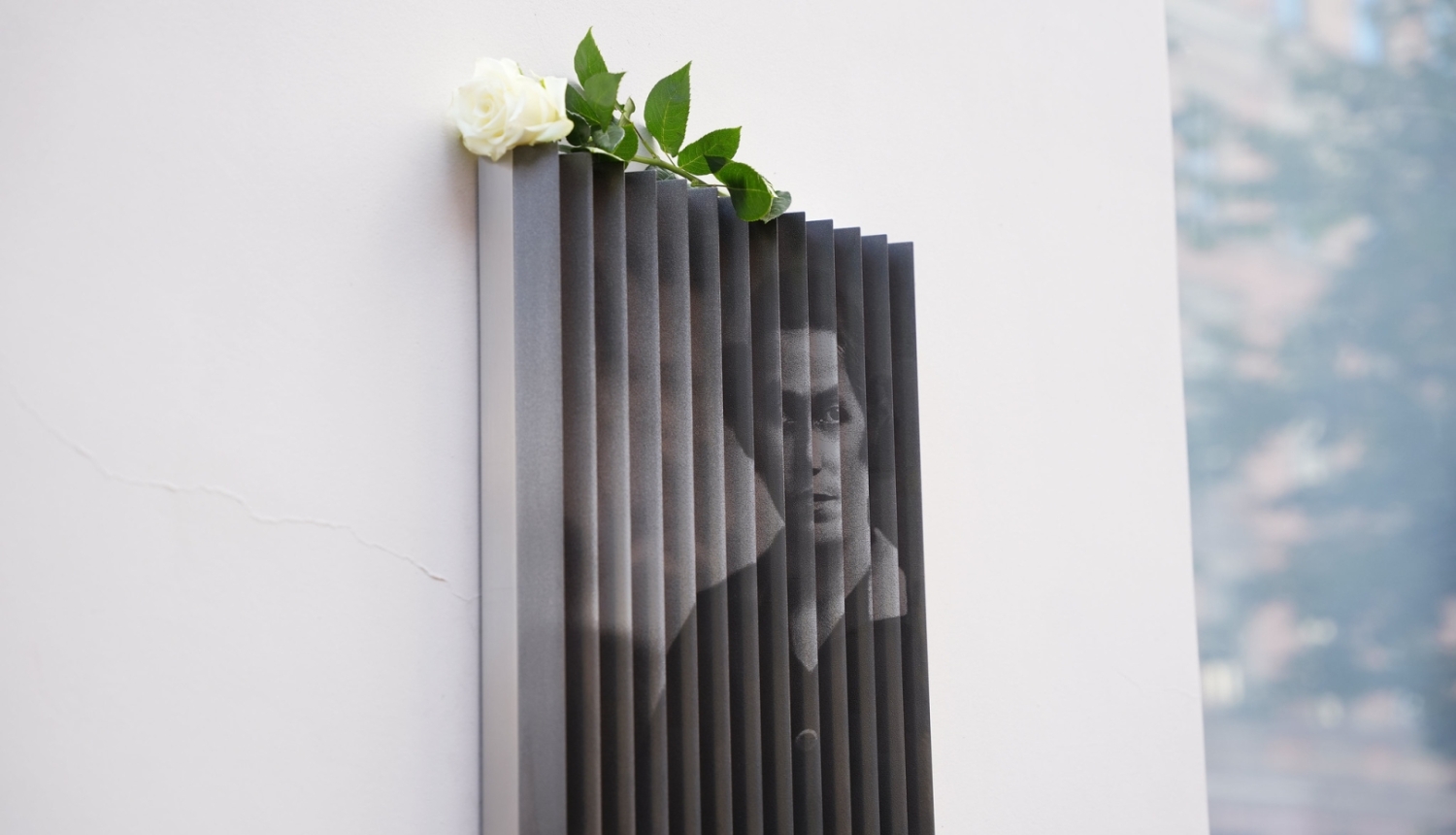
On Monday, September 28, on Berta Pīpiņa's birthday, a memorial plaque for two notable personalities of Riga and Latvia – politician, public figure and literary artist Berta Pīpiņa and her spouse, educator, literary critic, journalist and businessman Ērmanis Pīpiņš-Vizulis – was opened at the building at 69 Ģertrūdes Street.
The opening date was chosen symbolically in honour of Berta Pīpiņa, who was the first woman to be a member of the Riga City Council and the only woman elected to the Latvian Parliament during the interwar period. She was one of the most prominent public-political workers in the first half of the 20th century, actively advocated for women's participation in public life and for many years led the Latvian Women's National League.
“For us at the Riga Monuments Agency, it is important not only to install memorial signs, but also to bring back to the city the stories of people who are important in Latvian history - to make them think about their lives, what they have done, and to inspire them. In the case of Berta Pīpiņa and Ērmanis Pīpiņš-Vizulis, it is a story about two bright personalities, each of whom in their own way has left significant traces in the history of Latvia - Berta Pīpiņš in public and political life, advocating for women's rights, education and social issues, while Ērmanis Pīpiņš-Vizulis - in culture, journalism and public opinion. It is equally important that the memorial plaque itself is artistically significant. Its design and material solution must also be able to say something about the people it is dedicated to," says Agnese Strautiņa, Director of the Riga Monument Agency.
The memorial plaque is placed near the house, which is closely related to the Pīpiņi family. Ērmanis Pīpiņš-Vizulis built a six-storey masonry rental house on Ģertrūdes Street 69 in 1913 according to the project of architect Jānis Alksnis, which is a state-protected cultural monument today.
The granddaughter of Berta Pīpiņa, architect Māra Newsome-Sātiņa, also participated in the opening event of the plaque. She admitted that her grandmother was not remembered, because Berta Pīpiņa was repressed at a time when her granddaughter Māra was only two years old. On 14 June 1941, Berta Pipina was deported to Siberia. However, according to Māra Nūsomes-Sātiņa, she inherited courage, entrepreneurship and energy from her grandmother to act.
The commemorative plaque was created by artist and designer Armands Zelčs, but it was made by metal artist, designer and sculptor Uģis Traumanis. The shape of the plate invites the passer-by to engage in its observation - the images and message captured in it do not appear immediately, but gradually, as the viewpoint changes and passes or watches it from a distance.
The creation of the memorial plaque was initiated by historian Liene Dreimane. The idea was implemented by the Riga Monuments Agency, while funding was provided by the Riga Municipality.
The memory of Berta Pīpiņa in recent years has also been honoured in Riga in a different way. In 2025, her name was assigned to the section of the street from Eksporta Street to Citadele Street, thus reaffirming her significant place in the history of Latvian democracy and women's political participation.
Information prepared by: Antra Gabre, Project Coordinator, External Communication Division, Riga City Council, e-mail: antra.gabre@riga.lv
