


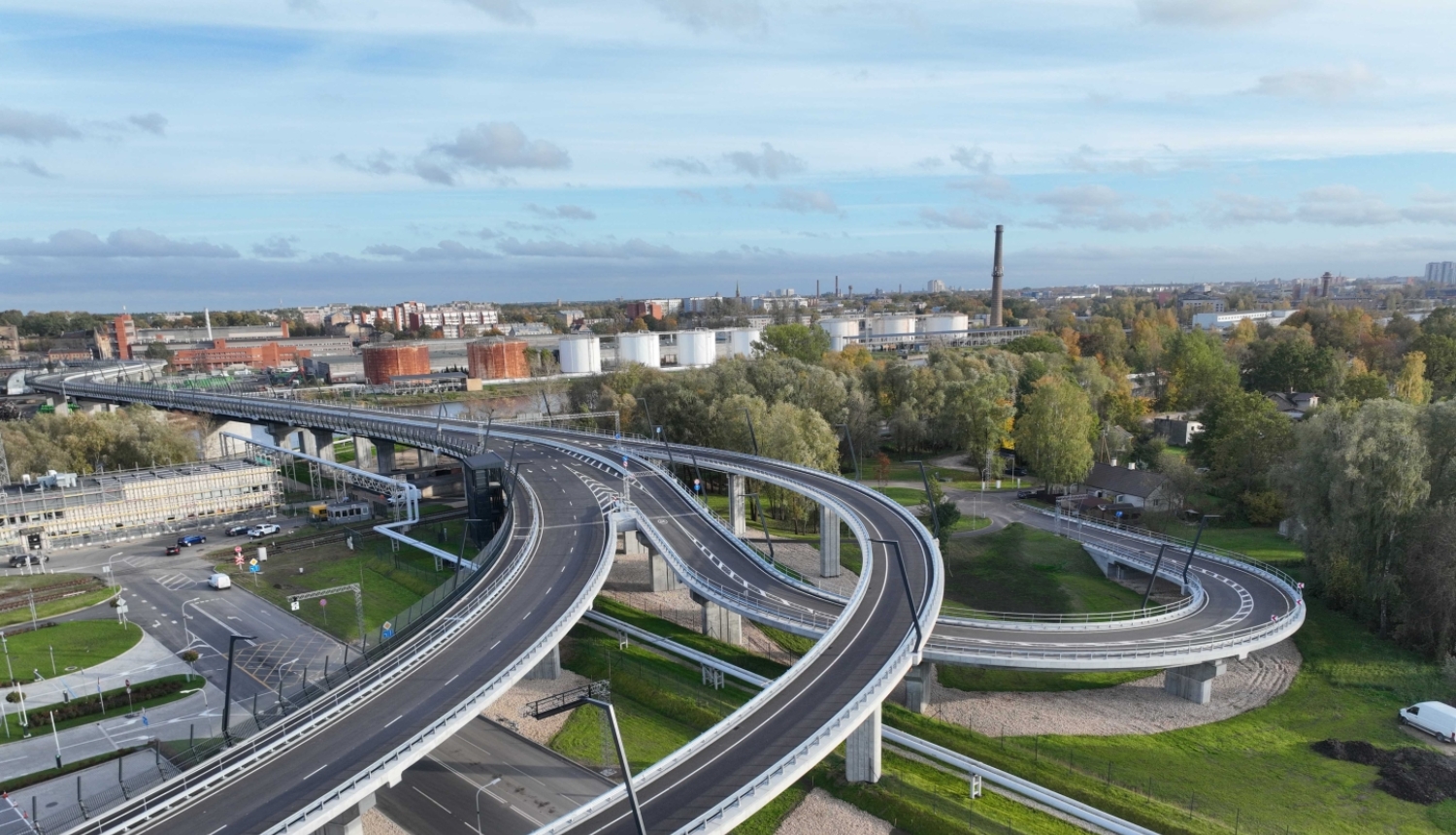
Construction works have been completed on one of the most ambitious transport infrastructure projects in Riga in recent years – the new traffic overpass connecting Tvaika Street to Kundziņsala. On Friday, 30 October, the official opening ceremony for the new overpass took place, and starting 1 November, the overpass will open to traffic, providing a new, direct connection between Kundziņsala and Riga’s arterial road network.
The new 863.5-metre-long overpass connects Tvaika Street in Sarkandaugava with the publicly accessible area of Kundziņsala and the industrial area of the Freeport of Riga. The overpass forms a vital section of Riga’s inner ring road and, together with the Eastern Arterial Road (Austrumu maģistrāle) and the Daudersala overpass, will enable freight transport to be routed more efficiently onto the city’s main road network, reducing the freight transport burden on the city centre and residential areas.
The Minister for Transport, Rihards Kozlovskis, emphasises: “Today marks the completion of eight years of crucial work. The Kundziņsala section is a major benefit not only for Riga, but for all of Latvia, particularly for enhancing the competitiveness of the Port of Riga – the new route improves access to the port’s terminals and industrial areas, while facilitating a more efficient flow of freight. It should also be emphasised that this project serves as an example of successful cooperation between the Ministry of Transport, the Riga City Council, the Freeport of Riga Authority and other partners.”
“The Kundziņsala overpass is one of the largest infrastructure projects delivered in Riga in recent years, and our city needs more projects like this, as they both improve the daily lives of residents and unlock opportunities for economic development. The new overpass will help divert freight traffic away from residential areas and improve access to the port. I would also like to thank my former colleagues at the Riga City Council who contributed to this project, as it is not possible to carry out such ambitious work within a single term of office. I am equally pleased with our cooperation with the Freeport of Riga, where each party has played its part so that today we can unveil a project that will benefit both Riga residents and business owners,” emphasises Viesturs Kleinbergs, Chairman of the Riga City Council.
“This is a long-awaited and strategically critical infrastructure project for the sustained economic growth of both the port and Riga as a whole. With the development of new, easily accessible industrial areas of the port within the region’s logistics chain, greater opportunities will open up for attracting investments, consolidating freight in the region and developing manufacturing and green energy, which will both create new jobs and boost Latvia’s overall competitiveness. At the same time, given the vital role of the Port of Riga in supporting military mobility, the new overpass will also strengthen our national security by improving the transit of military equipment and freight between the port and the national road network,” points out Ansis Zeltiņš, CEO of the Freeport of Riga Authority.
“The construction of the Kundziņsala overpass has been one of the most technically complex and large-scale infrastructure projects in Riga, during which we have overcome a number of engineering challenges. We have built an overpass exceeding 860 metres in length featuring eight viaduct structures, including a bridge across the Sarkandaugava tributary, the steel span structure of which was assembled using the intricate longitudinal launching method. Carrying out this work demanded high precision, professional expertise and close cooperation between all parties involved in the project. We are proud of our team’s accomplishments and of the joint contribution made by all three partners in the general partnership “RK link” – Hanza Construction Group, Binders and Tilts, in creating a significant infrastructure landmark that will contribute to the long-term development of Riga and its port. Our thanks go to the contracting authority, our partners and everyone involved in the construction for their trust and professional cooperation,” emphasises Edgars Vaivods, representative of the general partnership “RK link” and Project Manager at Hanza Construction Group.
A New Connection for the City and the Port
The new overpass is a vital component of Riga’s inner ring road infrastructure. It will improve traffic flow and enable freight transport to be routed more efficiently onto the Eastern Arterial Road (Austrumu maģistrāle), the Daudersala overpass and onward into the city’s and national arterial road networks.
Residents of Kundziņsala and Sarkandaugava will also benefit. Reduced heavy goods traffic in residential areas will translate into less noise, vibration and air pollution, while improving road safety and access to Kundziņsala.
The new infrastructure is not intended solely for road transport. An illuminated pedestrian and cycle path has been constructed, featuring special road markings for runners. Three lifts have also been installed – one on the Tvaika Street side and two on Kundziņsala. A dedicated turn-off leading into the residential area of Kundziņsala has also been incorporated.
The overpass is of strategic significance for the development of the Port of Riga. Direct connectivity with the city’s main road network will improve the speed and predictability of freight transport, the accessibility of port terminals and the overall competitiveness of the Port of Riga. Better connections to the city and national transport networks also establish essential preconditions for the further development of the Kundziņsala industrial area.
The Port of Riga checkpoints on Kundziņsala handle approximately 360,000 freight vehicles annually, or an average of 1,000 vehicles per day. With the opening of the new overpass, freight transport will be able to access the port bypassing the centre of Riga, thereby reducing traffic density, congestion and transport-related environmental impact.
Kundziņsala is concurrently evolving into a major industrial hub for Riga, hosting numerous logistics and freight-handling companies, including Latvia’s largest container transshipment and logistics hub. Ambitious renewable energy projects are also underway on the island, with up to half a billion euros in private capital slated for investment over the coming years, creating new jobs and strengthening Latvia’s energy independence and economy.
The new link will simultaneously improve the capacity for transporting military equipment and freight between the terminals at the Port of Riga and the national road network, thereby strengthening the port’s role in providing military logistics for Latvia and its allies.
Overpass Open to Traffic from 1 November
Starting 1 November, in tandem with the commissioning of the new overpass, operations will also commence at the new port checkpoint at 42 Uriekstes Street, designated as Delta 17. The checkpoint features six traffic lanes, automatic number plate recognition (ANPR), digital freight data exchange and integration with the information systems of the relevant control authorities. The Freeport of Riga Authority has invested €1.3 million in the checkpoint’s infrastructure.
By the end of 2026, freight transport will be permitted to use both the new overpass and Delta 17, as well as the existing Delta 1 checkpoint. Starting 1 January 2027, heavy goods traffic to and from the Kundziņsala port terminals will be routed exclusively via the new overpass through Delta 17.
A Technically Complex Infrastructure Project
The length of the main alignment of the overpass is 863.56 metres. Additionally, a 122.61-metre-long two-lane slip road and a 194.46-metre-long single-lane slip road have been constructed. The overpass consists of eight elevated viaduct structures incorporating diverse structural engineering solutions.
The fourth viaduct – a bridge across the Sarkandaugava tributary – is particularly complex. It comprises three parallel 148.88-metre-long main steel girders configured with a span arrangement of 41.35 + 65 + 41.35 metres. The steel structure was assembled on the riverbank and, using the longitudinal launching method, was moved across the water in stages over approximately four months.
All piers and supports of the overpass are constructed of cast-in-place reinforced concrete. The foundations use bored piles ranging from 13 to 23 metres in depth depending on geotechnical conditions, while the piles supporting the river piers reach depths of approximately 26 to 27 metres.
The overpass crosses three railway lines, an above-ground petroleum products pipeline at two locations, and the Sarkandaugava tributary. It is also equipped with a weather station, CCTV infrastructure and new traffic lights, the control units for which can be connected to the traffic management system.
The construction of the traffic overpass is a joint project between the Riga City Council and the Freeport of Riga Authority. The total cost of the project is €82.6 million.
The main contractor for the construction works is the general partnership “RK link”, comprising LLC “Hanza Construction Group”, the road construction firm LLC “Binders” and LLC “Tilts”. The project has been designed by LLC “Vektors T”, while construction supervision is being carried out by LLC “Firma L4”.
he main contractor for the project activities carried out by the Freeport of Riga Authority is LLC “Asfaltbūve”. Construction supervision is provided by LLC “Geo Consultants”, while LLC “ROVLAN GROUP” and LLC “ELTORS” are the main subcontractors.
Information was prepared by Kristīne Krista Vītola, Project Coordinator of the Department of External Communication of the Communication Department of the Riga City Council, e-mail: kristine.vitola@riga.lv
